


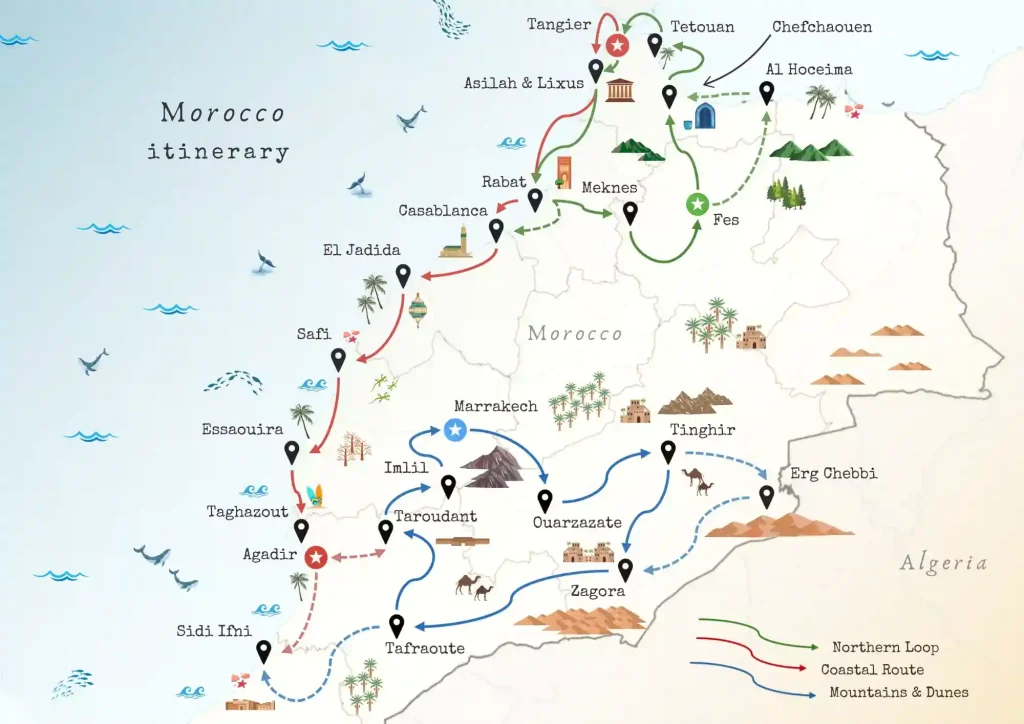
There is no better way to discover the real Morocco than behind the wheel of a car or campervan, windows down, the smell of thyme and cedar drifting in from the roadside. A Morocco road trip is not simply a way to get from one city to another — it is the experience itself. The moment you leave the motorway and turn onto a winding mountain pass or a desert piste, Morocco reveals a version of itself that most tourists never see.
From the snow-capped peaks of the High Atlas to the hammered gold of the Sahara, from crumbling Atlantic ramparts to lush river valleys lined with ancient kasbahs, a Morocco road trip delivers landscapes of almost unreasonable beauty at every turn. This guide covers the best routes, the roads less traveled, practical driving advice, and the hidden gems that will make your journey unforgettable.
Why a Morocco Road Trip is the Ultimate Way to Travel
Morocco is a country built for road travel. Its territory spans over 700,000 square kilometers, and the diversity packed into that space — desert, mountain, coast, forest, and fertile plain — simply cannot be experienced from a train window or a tour bus seat. A Morocco road trip puts you in control. You stop when something catches your eye, you sleep where the view demands it, and you take detours that lead to places no guidebook has ever named.
The country's road network has improved dramatically in recent years. A modern toll motorway system connects all major cities quickly and reliably. But the real magic of a Morocco road trip happens on the secondary roads — the N and R routes that snake through the Atlas Mountains, trace the edges of desert valleys, and drop down into coastal towns where the Atlantic crashes against ancient stone walls.
For those who want the ultimate freedom, Morocco camping car location — renting a campervan or motorhome — transforms a road trip into a fully mobile adventure. You carry your accommodation with you, camp wild in the desert or beside the ocean, and never pay a hotel bill. Campervan rental services are available in Casablanca, Marrakech, and Agadir, with vehicles suited to every budget and group size.
Route 1: The Imperial Cities Circuit
Distance: approximately 600 km Duration: 7 to 10 days Starting point: Casablanca
This is the classic Morocco road trip for first-time visitors, connecting the four great imperial cities of the kingdom in a logical and rewarding loop.
Begin in Casablanca, where the Hassan II Mosque — one of the largest in the world — rises dramatically above the Atlantic. Spend a morning exploring the Art Deco architecture of the old city centre before heading north along the coast to Rabat, Morocco's elegant capital. The Kasbah of the Udayas, the ancient Chellah necropolis, and the wide palm-lined boulevards make Rabat one of the most underrated cities in the country.
From Rabat, head east to Meknes, a city of imperial grandeur that receives a fraction of the visitors it deserves. The monumental Bab Mansour gate is one of the most spectacular pieces of architecture in all of North Africa. Nearby, the Roman ruins of Volubilis — just 33 kilometres from Meknes — are remarkably well preserved and sit in a landscape of rolling wheat fields that feels almost Italian.
Continue east to Fes, the spiritual heart of Morocco and the cultural highlight of this route. Allow at least two full days here. The medina of Fes el-Bali is the largest car-free urban area in the world, a labyrinthine city of over 9,000 streets where medieval life continues largely unchanged. The Chouara tanneries, the madrasa of Bou Inania, and the Al-Qarawiyyin mosque — founded in 859 AD and recognised as the world's oldest continuously operating university — are unmissable.
From Fes, drive southwest to Marrakech via the Middle Atlas, passing through the cedar forests of Azrou where Barbary macaques roam freely, and the charming hill town of Ifrane, nicknamed "Little Switzerland" for its Alpine-style architecture and winter snowfall. This mountain stretch is one of the most scenic drives on the entire Morocco road trip circuit.
Route 2: The Desert and Kasbahs Route
Distance: approximately 1,000 km Duration: 10 to 14 days Starting point: Marrakech
This is the road trip that defines Morocco in the imagination of most travelers — the journey south through the High Atlas, across the Valley of a Thousand Kasbahs, and into the Sahara Desert. It is breathtaking from start to finish.
Leave Marrakech heading south on the N9, climbing immediately into the High Atlas Mountains. The Tizi n'Tichka pass, at 2,260 metres above sea level, is the highest road pass in North Africa and offers views of snow-capped peaks and plunging gorges that demand frequent stops. The drive is exhilarating and the road is well maintained, though narrow in places — take your time.
On the southern side of the Atlas, the landscape transforms almost immediately. The air becomes drier, the colours shift to ochre and terracotta, and the first kasbahs appear against the hillsides. Stop at Aït Benhaddou, a UNESCO World Heritage Site and one of the best-preserved earthen ksar complexes in the world. This fortress village has served as the backdrop for films including Gladiator, Lawrence of Arabia, and multiple Game of Thrones episodes. Arrive early in the morning to experience it without the tour groups.
Continue to Ouarzazate, the self-proclaimed "Hollywood of Africa," where several major film studios have operated for decades. From here, the famous Route of the Kasbahs — the N10 — runs east through the Draa and Dadès valleys, past an almost continuous procession of mud-brick fortresses, palm oases, and Berber villages. The Todgha Gorge near Tinghir is a spectacular narrow canyon where walls of rock rise 300 metres above a clear river — a paradise for hikers and climbers.
The road trip culminates at Merzouga and the dunes of Erg Chebbi, the great sea of orange sand that most people picture when they think of the Sahara. Park your vehicle, rent a camel, and ride out into the dunes at sunset. Spend the night in a desert camp listening to Gnawa music under a sky so thick with stars it barely seems real. This is the emotional centre of any Morocco road trip, and it delivers every single time.
Route 3: The Atlantic Coast Road Trip
Distance: approximately 800 km Duration: 8 to 12 days Starting point: Tangier
Morocco's Atlantic coastline runs for over 2,500 kilometres from Tangier in the north to Lagouira on the edge of Mauritania in the south. A coastal Morocco road trip along even a portion of this shoreline reveals a completely different side of the country — windswept, wild, and deeply atmospheric.
Begin in Tangier, the legendary gateway city at the meeting point of the Atlantic and the Mediterranean. Tangier has been reinvented in recent years as a modern cultural hub, with a revitalised waterfront, excellent restaurants, and a fascinating medina that once drew writers like Paul Bowles, Jack Kerouac, and William Burroughs.
Drive south along the coast through the resort town of Asilah, one of Morocco's most charming small cities, its whitewashed medina walls covered every August in enormous murals during the international arts festival. Continue to Rabat and Casablanca before turning south again toward El Jadida, home to a stunning Portuguese cistern that floods visitors with an eerie, reflected light.
The coast road continues through Oualidia, a sleepy lagoon town famous throughout Morocco for the finest oysters in the country, before reaching Essaouira — undoubtedly the jewel of the Atlantic coast. Its blue-and-white medina, constant Atlantic wind, thriving arts scene, and extraordinary seafood make it a place where many road trippers intend to stay one night and end up staying five.
South of Essaouira, the road passes through the Argan forest — a UNESCO Biosphere Reserve unique to this corner of the world — before arriving at Agadir, the resort capital of southern Morocco. From Agadir, adventurous road trippers can continue south into the wild Souss-Massa National Park, the dramatic coastal cliffs around Sidi Ifni, and eventually the vast empty landscapes of the Western Sahara.
Hidden Gems of the Morocco Road Trip
The best discoveries on any Morocco road trip are the ones you stumble upon. These are the places that rarely make the front page of travel magazines but stay with you for years.
Moulay Idriss Zerhoun sits above the plains near Meknes like a secret kept by the mountains. Morocco's holiest city, built around the tomb of Moulay Idriss I — the founder of the first Moroccan dynasty — it receives almost no foreign tourists despite its extraordinary atmosphere and views. The town spirals up two rocky peaks, its white-and-green buildings clinging to the hillside in a composition that looks almost painted.
Imilchil in the Central High Atlas is one of the most remote and beautiful villages in Morocco, famous for its annual September moussem — a traditional Berber marriage festival where hundreds of men and women from surrounding tribes gather to find partners. The drive to reach it, through high plateaus and canyon roads, is itself one of the great experiences of a Morocco road trip.
Tafraout in the Anti-Atlas Mountains is an oasis town surrounded by a landscape of giant pink granite boulders that glow salmon and copper in the evening light. The surrounding valleys, planted with almond trees that bloom in February, are unlike anything else in Morocco.
Nkob, a quiet village in the Draa Valley, has more kasbahs per square kilometre than anywhere else in Morocco — 45 in total, many still inhabited, rising from a sea of date palms. It sees almost no tourists and offers wild camping spots of extraordinary beauty.
Driving Tips for Your Morocco Road Trip
Driving in Morocco is generally straightforward but requires preparation and awareness. Roads in cities can be chaotic, with mopeds, donkey carts, and pedestrians all sharing the same narrow spaces. Outside urban areas, the main routes are well maintained and clearly signposted in both Arabic and French.
Speed limits are strictly enforced by radar on major roads — 120 km/h on motorways, 100 km/h on national roads, and 40 to 60 km/h in towns. Gendarmerie checkpoints are common, particularly in the south, but are routine for foreign tourists and rarely cause delays.
Mountain roads in the Atlas require confidence and patience. Many are single-lane with passing places, and large vehicles such as campervans need extra care on tight bends. Always check weather conditions before crossing mountain passes in winter, as snow can close roads without warning.
Fuel stations are plentiful between major towns but can be scarce in very remote areas. On the southern desert routes, always fill your tank when you have the opportunity. Carrying an extra five litres of water per person is strongly recommended when driving through desert regions.
Campervan Travel on a Morocco Road Trip
A Morocco road trip reaches its fullest potential when you travel by camping car. The freedom to stop wherever the landscape calls, to cook your own food beside a palmerie, to wake up with the dunes outside your window — this is the experience that turns a holiday into a genuine adventure.
Morocco camping car location services have expanded significantly in recent years. Agencies in Casablanca, Marrakech, and Agadir offer a range of vehicles from two-person converted vans to eight-metre motorhomes with full kitchen, bathroom, and solar power. Most rental packages include essential equipment and roadside assistance cover.
Wild camping is widely practised and generally tolerated outside urban areas. The south of Morocco — the Draa Valley, the Saharan pistes, the Atlantic coast between Tiznit and Tan-Tan — offers some of the finest wild camping terrain in the world. Designated campsites exist in most tourist areas and charge between 50 and 120 dirhams per night for a pitch with electricity and water.
FAQ: Morocco Road Trip
Is it safe to drive in Morocco as a foreign tourist? Yes. Morocco is considered one of the safer countries in Africa for road travel. Foreign tourists drive independently throughout the country every day without incident. Standard road safety precautions apply, and driving after dark in unfamiliar rural areas is best avoided.
What is the best vehicle for a Morocco road trip? A 4x4 or high-clearance vehicle is recommended if you plan to venture onto pistes — unpaved desert tracks. For paved routes, including all the itineraries in this guide, a standard car or campervan is perfectly adequate.
Do I need an international driving permit for a Morocco road trip? It is not legally required for EU, UK, or US citizens, but it is strongly recommended as an additional document at police checkpoints, particularly in rural areas.
What is the best season for a Morocco road trip? March to May and September to November offer the most comfortable driving conditions across all regions. Summer is very hot in the interior but pleasant on the coast. Winter is ideal for the southern desert routes and offers dramatic snow scenery in the Atlas.
Can I cross into other countries from Morocco by road? The land border with Algeria has been closed since 1994. The borders with Mauritania via the Western Sahara are open but require careful preparation, a reliable 4x4, and up-to-date travel advice before attempting.
Conclusion
A Morocco road trip is one of those rare travel experiences that exceeds every expectation. The landscapes shift so dramatically from one hour to the next that you feel you are crossing multiple countries in a single day. The people you meet along the roadside, the mint tea pressed into your hands at a mountain guesthouse, the silence of the desert at 5am — these are the moments that make the journey.
Whether you choose the imperial cities circuit, the desert kasbah route, the wild Atlantic coast, or a combination of all three, the road will give you more than you came looking for. Load up your campervan, plan your first night loosely, and leave the rest open. That is the only rule of a great Morocco road trip.